
2011-11-02
Moxibustion
Moxibustion (Chinese: 灸; pinyin: jiǔ) is a traditional Chinese medicine therapy using moxa, or mugwort herb. It plays an important role in the traditional medical systems of China, Japan, Korea, Vietnam, Tibet, and Mongolia. Suppliers usually age the mugwort and grind it up to a fluff; practitioners burn the fluff or process it further into a stick that resembles a (non-smokable) cigar. They can use it indirectly, with acupuncture needles, or burn it on the patient's skin.

2011-10-28
Yoga & Body Mind Spirit

Eating For Energy - Raw Food Diet For Weight Loss
Click Here!
Brilliant Yoga
Click Here!
Online Yoga Teacher's Training And Certification Program
Click Here!
Meditation And Yoga Certification Program
Click Here!
Yoga Weight Loss System
Click Here!
Pregnancy Yoga Classes Online
Click Here!
2011-10-26
Bian Stone Therapy
Bian Stones are generally used as an instrument similar to acupuncture needles. It is a tool to treat back & neck pain. The therapy used to be an original form of acupuncture, which utilize "Bian Stone" to perform treatment, instead of using needles. These stones are made of materials found in the coast of Shan Dong, China.


2011-10-13

2011-09-30
Face Acupuncture and Massage
 |
| use a bottle to roll your chin |
 |
| massage your chin with metacarpophalangeal joints |
 |
| hold the bottom of your chin and roll to the two side |
 |
| massage your chin w/ two fists |
2011-09-24

Facial Rejuvenation Acupuncture


Commonly known as cosmetic acupuncture, acupuncture facials, or an acupuncture face lift, it has attracted great attention in the last few years, especially in the big cities like New York and Los Angeles. It used to be a treatment only for the rich and famous in Hollywood. "A 1996 report in the international journal of clinical acupuncture reported that among 300 cases treated with cosmetic acupuncture, 90% had marked the effects with one course of treatment. The effect include: The skin becomes improved of elasticity of facial muscles, ruddier complexion, and overall rejuvenation."
2011-09-19

2011-09-14

2011-09-12
Basic principles of pattern discrimination (八纲辩证)
The process of determining which actual pattern is on hand is called 辩证 (pinyin: biàn zhèng, usually translated as "pattern diagnosis", "pattern identification" or "pattern discrimination"). Generally, the first and most important step in pattern diagnosis is an evaluation of the present signs and symptoms on the basis of the "Eight Principles" (八纲,pinyin: bā gāng).
These eight principles refer to four pairs of fundamental qualities of a disease: exterior/interior, heat/cold, vacuity/repletion, and yin/yang. Out of these, heat/cold and vacuity/repletion have the biggest clinical importance.The yin/yang quality, on the other side, has the smallest importance and is somewhat seen aside from the other three pairs, since it merely presents a general and vague conclusion regarding what other qualities are found.In detail, the Eight Principles refer to the following:
These eight principles refer to four pairs of fundamental qualities of a disease: exterior/interior, heat/cold, vacuity/repletion, and yin/yang. Out of these, heat/cold and vacuity/repletion have the biggest clinical importance.The yin/yang quality, on the other side, has the smallest importance and is somewhat seen aside from the other three pairs, since it merely presents a general and vague conclusion regarding what other qualities are found.In detail, the Eight Principles refer to the following:
The Six Excesses (六淫)
The Six Excesses (六淫, pinyin: liù yín, sometimes also translated as "Pathogenic Factors", or "Six Pernicious Influences"; with the alternative term of 六邪, pinyin: liù xié, - "Six Evils" or "Six Devils") are allegorical terms used to describe disharmony patterns displaying certain typical symptoms. These symptoms resemble the effects of six climatic factors. In the allegory, these symptoms can occur because one or more of those climatic factors (called 六气, pinyin: liù qì, "the six qi") were able to invade the body surface and to proceed to the interior. This is sometimes used to draw causal relationships (i.e., prior exposure to wind/cold/etc. is identified as the cause of a disease), while other authors explicitly deny a direct cause-effect relationship between weather conditions and disease, pointing out that the Six Excesses are primarily descriptions of a certain combination of symptoms translated into a pattern of disharmony.
Concept of Disease (症. 病. 证的关系)
In general, disease is perceived as a disharmony (or imbalance) in the functions or interactions of yin, yang, qi, xuĕ, zàng-fǔ, meridians etc. and/or of the interaction between the human body and the environment.
2011-09-10
Five Element theory (五行學說)
The following list of Five Phase correspondences gives some idea of the elaborate nature of this theory as it pertains to every aspect of our lives in space and through time. It is also the philosophical basis of Chinese astrology and the practice of Feng Shui.
The Zang-fu (藏象學說)
Zang-fu in context of yin/yang and the Five Elements
Each zàng-fǔ organ has a yin and a yang aspect, but overall, the zàng organs are considered to be yin, and the fǔ organs yang.
Since the concept of the zàng-fǔ was developed on the basis of Wǔ Xíng philosophy, they're incorporated into a system of allocation to one of five elemental qualities (i.e., the Five Elements or Five Phases). The zàng-fǔ share their respective element's allocations (e.g., regarding colour, taste, season, emotion etc.) and interact with each other cyclically in the same way the Five Elements do: each zàng organ has one corresponding zàng organ that it enfeebles, and one that it reinforces.

TCM model of the body (中医理論)
TCM's view of the human body is only marginally concerned with anatomical structures, but focuses primarily on the body's functions (such as digestion, breathing, temperature maintenance, etc.)
The primary functional entities used by traditional Chinese medicine are qì, xuě, the five zàng organs, the six fǔ organs, and the meridians which extend through the organ systems. These are all theoretically interconnected: each zàng organ is paired with a fǔ organ, which are nourished by the blood and concentrate qi for a particular function, with meridians being extensions of those functional systems throughout the body.

The primary functional entities used by traditional Chinese medicine are qì, xuě, the five zàng organs, the six fǔ organs, and the meridians which extend through the organ systems. These are all theoretically interconnected: each zàng organ is paired with a fǔ organ, which are nourished by the blood and concentrate qi for a particular function, with meridians being extensions of those functional systems throughout the body.

Five Phases (五行學說) and Yin-yang theory (阴阳學說)
Traditional Chinese Medicine (TCM) is based on Yinyangism (i.e., the combination of Five Phases theory with Yin-yang theory), which was later absorbed by Daoism.
Five Phases theory
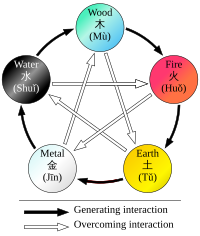
Interactions of Wu Xing

Five Phases theory
Five Phases (五行, pinyin: wǔ xíng, sometimes also translated as "Five Elements") theory presumes that all phenomena of the universe and of nature can be broken down into five elemental qualities - represented by wood (木, pinyin: mù), fire (火pinyin: huǒ), earth (土, pinyin: tǔ), metal (金,pinyin: jīn), and water (水, pinyin: shuǐ).
Acupuncture

Acupuncture is an alternative medicine that treats patients by insertion and manipulation of needles in the body. Its proponents variously claim that it relieves pain, treats infertility, treats disease, prevents disease, or promotes general health. The earliest written record of acupuncture is found in the Huangdi Neijing (黄帝内经; translated as The Yellow Emperor's Inner Canon), dated approximately 200 BCE.
Traditional Chinese Medicine
Traditional Chinese Medicine (simplified Chinese: 中医; traditional Chinese: 中醫; pinyin: zhōng yī: "Chinese Medicine") refers to a broad range of medicine practices sharing common theoretical concepts which have been developed in China and look back on a tradition of more than 2000 years, including various forms of herbal medicine, acupuncture, massage therapy, and dietary therapy.[1] These practices are a common part of medical care throughout East Asia, but are considered alternative medicine in the western world.


訂閱:
文章 (Atom)