Five Phases theory
Five Phases (五行, pinyin: wǔ xíng, sometimes also translated as "Five Elements") theory presumes that all phenomena of the universe and of nature can be broken down into five elemental qualities - represented by wood (木, pinyin: mù), fire (火pinyin: huǒ), earth (土, pinyin: tǔ), metal (金,pinyin: jīn), and water (水, pinyin: shuǐ).
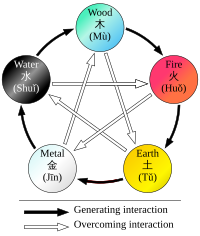
Generating
- Wood feeds Fire;
- Fire creates Earth (ash);
- Earth bears Metal;
- Metal carries Water (as in a bucket or tap, or water condenses on metal);
- Water nourishes Wood.
Other common words for this cycle include "begets", "engenders" and "mothers."
Overcoming
- Wood parts Earth (such as roots) (or Trees can prevent soil erosion );
- Earth absorbs (or muddies) Water (or Earth dam control the water);
- Water quenches Fire;
- Fire melts Metal;
- Metal chops Wood.
Also:
- Wood absorbs Water;
- Water rusts Metal;
- Metal breaks up Earth;
- Earth smothers Fire;
- Fire burns Wood.
This cycle might also be called "controls", "restrains" or "fathers".
Yin and yang
Yin and yang are ancient Chinese concepts which can be traced back to the Shang dynasty (1600-1100 BC). They represent two abstract and complementary aspects every phenomenon in the universe can be divided into. Primordial analogies for these aspects are the sun-facing (yang) and the shady (yin) side of a hill. Two other commonly used representational allegories of yin and yang are water and fire. In yin-yang theory, detailed attributions are made regarding the yin or yang character of things:
| Phenomenon | Yin | Yang |
|---|---|---|
| Celestial bodies | moon | sun |
| Gender | female | male |
| Location | inside | outside |
| Temperature | cold | hot |
| Direction | downward | upward |
| Degree of humidity | damp/moist | dry |

The concept of yin and yang is also applicable to the human body; for example, the upper part of the body and the back are assigned to yang, while the lower part of the body are believed to have yin character. Yin and yang characterization also extends to the various body functions, and - more importantly - to disease symptoms (e.g., cold and heat sensations are assumed to be yin and yang symptoms, respectively). Thus, yin and yang of the body are seen as phenomena whose lack (or overabundance) comes with characteristic symptom combinations:
- Yin vacuity (also termed "vacuity-heat"): heat sensations, possible night sweats, insomnia, dry pharynx, dry mouth, dark urine, a red tongue with scant fur, and a "fine" and rapid pulse.
- Yang vacuity ("vacuity-cold"): aversion to cold, cold limbs, bright white complexion, long voidings of clear urine, diarrhea, pale and enlarged tongue, and a slightly weak, slow and fine pulse.
TCM also identifies drugs believed to treat these specific symptom combinations, i.e., to reinforce yin and yang.
~ From Wikipedia, the free encyclopedia

沒有留言:
張貼留言